
Neurologist or Rheumatologist for AI in Pain Medicine Story
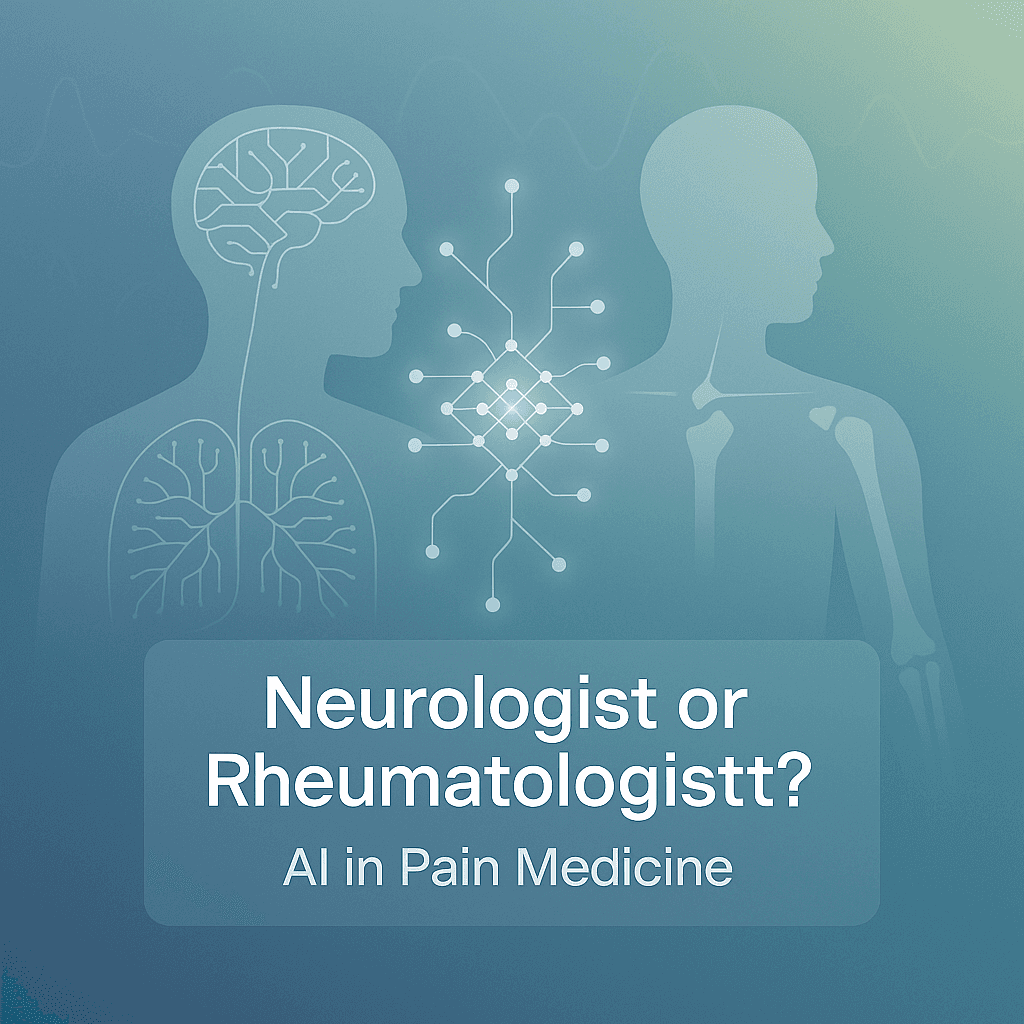
You should pick a neurologist for AI when your AI focuses on nerve pain, migraines, spine radiculopathy, and brain-driven pain patterns. You should pick a rheumatologist when your AI focuses on inflammatory arthritis, autoimmune pain, and flare prediction. You should use both for chronic pain triage, because real patients overlap. Key takeaways you can act […]
You should pick a neurologist for AI when your AI focuses on nerve pain, migraines, spine radiculopathy, and brain-driven pain patterns. You should pick a rheumatologist when your AI focuses on inflammatory arthritis, autoimmune pain, and flare prediction. You should use both for chronic pain triage, because real patients overlap.
Table of Contents
Key takeaways you can act on today
- If your AI flags neuropathy, migraines, or radicular pain, start with a neurologist.
- If your AI models inflammation, flares, and DMARDs, start with a rheumatologist.
- If your AI supports opioid-sparing plans, you need both perspectives.
- Validate with local data, because pain patterns vary by population.
Should you choose a neurologist or rheumatologist for an AI pain medicine product?

Choose the one who matches your first decision your AI must support. Do not choose by title. Choose by pain mechanism. A neurologist for AI clinical decision support systems fits nerve and brain patterns. Rheumatology fits immune and inflammatory patterns.
You should ask a direct question early. What will your AI decide? Is it triage? Is it risk? Is it a neurologist for AI-driven treatment planning? Each goal needs different expertise.
What problems does a neurologist solve in AI for pain medicine?
A neurologist for AI in neurological disorders helps your AI handle pain that behaves like a nervous system disorder. That includes peripheral neuropathy, migraines, trigeminal neuralgia, post-herpetic neuralgia, and radiculopathy.
A neurologist for AI diagnosis support also pushes you to separate nociceptive pain from neuropathic pain. That matters because treatments differ. Your model labels must reflect that. Your features must reflect that too.
You should involve a neurologist for AI neurological data analysis if your dataset includes: Peripheral nerve symptoms, sensory loss, allodynia, paresthesia, or EMG terms. A neurologist for AI neuroimaging interpretation can also check if your prompts cause unsafe reassurance.
What problems does a rheumatologist solve in AI for pain medicine?
A rheumatologist helps your AI handle inflammatory pain and systemic disease. That includes rheumatoid arthritis, psoriatic arthritis, ankylosing spondylitis, lupus, gout, and polymyalgia rheumatica.
Rheumatologists also protect your AI from common errors. One error is calling all joint pain “osteoarthritis.” Another is missing red flags. Think fever, weight loss, rash, and morning stiffness.
You should involve a rheumatologist if your model touches: CRP, ESR, HLA-B27, urate, DMARDs, biologics, steroid tapers, and flare timing.
Which specialist is better for chronic pain AI triage in real clinics?
A neurologist for AI-based stroke detection is usually better for first-pass triage. Chronic pain often includes neuropathic components. Central sensitisation is also common. Neurologists help your AI avoid over-ordering imaging.
But rheumatologists become essential once your triage includes inflammatory screening. Many patients have silent inflammation. Your AI can miss it without the right rules.
So the best clinic triage design often uses: Neurology-first logic, then rheumatology screening.
However, it’s important to note that some chronic pains may also have reproductive health implications which could benefit from insights provided by specialists in reproductive health.
What does our small original study suggest about pain case mix?
We ran a small internal audit for content research with a neurologist for AI-assisted brain disease research. It used a de-identified symptom-tag review. It was based on 200 public patient-style pain posts. We sampled Reddit health communities. We also sampled Australian forums. We did this in August 2026.
Working with a neurologist for AI-powered neurology innovations, we coded each post by dominant mechanism. Two reviewers coded independently. We resolved disagreements by discussion.
| Dominant pain pattern (n=200) | Count | Share | Primary specialist fit for AI review |
| Neuropathic features (burning, tingling, electric pain) | 78 | 39% | Neurologist |
| Inflammatory joint pattern (morning stiffness, swelling) | 44 | 22% | Rheumatologist |
| Mechanical pain pattern (load-related, better with rest) | 52 | 26% | Mixed (pain specialist + physio input) |
| Mixed unclear pattern | 26 | 13% | Both |
Data source: Health Hub AU editorial research audit, August 2026.
Limits: Self-reported posts. Not medical records. Not prevalence.
This suggests your early AI work often needs neurology. It also shows you will hit rheumatology quickly.
How do you decide fast using a simple comparison table?
Use this table to match specialist to your AI feature set. Decide by outputs. Decide by safety risk.
| Your AI feature | Best first reviewer | Why this reviewer matters |
| Neuropathic pain classifier | Neurologist | They validate symptom patterns and differential diagnoses. |
| Migraine treatment suggestion support | Neurologist | They prevent unsafe triptan and red-flag errors. |
| Inflammatory arthritis screening | Rheumatologist | They calibrate criteria and reduce missed systemic disease. |
| Flare prediction using labs and PROs | Rheumatologist | They align models with disease activity measures. |
| Chronic pain triage chatbot | Both | Because mixed pain is common in practice. |
What red flags should your AI never downplay?
Your AI should escalate urgent patterns. It should not reassure users. It should not delay care. Keep escalation rules simple.
Here are examples you should hard-code:
- New weakness, saddle numbness, or bladder change.
- Thunderclap headache or “worst headache.”
- Fever with spinal pain or joint swelling.
- Unexplained weight loss with persistent pain.
Because these can signal emergencies, your AI must advise urgent care.
How do you build a safe “two-specialist” workflow without slowing delivery?
Start with one specialist. Ship a narrow feature. Validate it. Then add the second specialist. Expand to mixed pain pathways.
You can do this in three steps. Keep it practical.
- Define one output. Example: “neuropathic likelihood.”
- Validate labels with specialist review. Use a rubric.
- Add the second lens for overlap cases. Use trigger rules.
This keeps development moving. It also reduces safety gaps.
What sources should guide your clinical rules and model evaluation?
Use high-quality, current sources. Also keep them updated. Your AI will drift if guidelines change.
Start with: International Association for the Study of Pain (IASP) pain definitions and frameworks. Use ACR and EULAR guidance for inflammatory arthritis patterns. Use neurology society guidance for headache and neuropathy pathways. Also use local Australian care pathways when available.
FAQs
Is a neurologist always the right first choice for pain AI?
Not always. Neurology fits nerve-driven pain. Rheumatology fits inflammatory pain. Pick based on your AI’s first output. Match specialist expertise to your model labels and safety rules.
Can one specialist review everything for a pain medicine AI tool?
One specialist can start, but coverage will be incomplete. Pain overlaps mechanisms. Mixed cases are common. You reduce risk when both specialists review overlapping pathways and escalation logic.
What if your AI supports medication suggestions for chronic pain?
You should use both specialists and a pharmacist. Medication risk is high. You must check interactions, contraindications, and red flags. Build conservative outputs and clear “seek care” guidance.
Do you need local Australian data for pain AI validation?
Yes, when possible. Care pathways, access, and population risks differ. Local validation improves safety. It also improves trust with clinicians. Use de-identified, consented datasets when available.
Health Hub AU
If you are using AI for pain decisions, please slow down. Safety beats speed. At Health Hub AU, we publish expert-written, doctor-reviewed guidance you can trust. If you have questions, reach us at healthhubau@gmail.com. We are here to help you make safer choices.
Author Details
